“‘What is truth?’ Pilate asked.”
— John 18:38
The silent era’s most commercially-successful release pioneered the American epic film and crucially developed the establishing shot, the close-up, the panoramic view, the flashback, and intercutting. It also featured blackface, championed the Ku Klux Klan, and had a white Southern maiden leap from a cliff to her death to escape the Negro Union soldier relentlessly pursuing her. In D. W. Griffith’s 195-minute The Birth of a Nation (1915)—adapting Thomas Dixon’s novel The Clansman (1905)—black Americans rig an election and black politicians are shown in the state legislature plopping their bare feet up onto the desks as they drink whisky and eat fried chicken; the movie’s hero founds the KKK after his Eureka!-moment of seeing white

children don white sheets to scare black children.
The National Association for the Advancement of Colored People strenuously fought the movie’s release, to no avail. In Indiana, a white man came out of a showing and shot dead a Negro teenager; the re-launched KKK made its first public appearance outside the movie’s Atlanta premiere (the group would have around 3 million members at its peak, a decade later); the Klan was still using The Birth of a Nation as a recruitment-tool in the 1970s. As critic Xan Brooks notes, “the movie is rancid . . . [it] is cinema’s toxic tide-pool, its corrupted semen. It is the original sin that sired a century of dreams.”
Twenty years after Griffith’s infamous work came another that would be studied in university classrooms and outside them, by such directors as George Lucas, Ridley Scott, and Peter Jackson. It would influence the Rockefeller-for-President TV ads and the medal ceremony capping Star Wars. Leni Riefenstahl’s Triumph of the Will (1935) celebrates the 1934 Congress of the National Socialist Workers’ Party, held in early September in Nuremberg. After an astounding aerial opening, tracking the plane of party-leader Adolf Hitler, this supposed documentary (actually financed to the hilt by the party, with many scenes staged for the cameras) touches down and tank-trundles along, relentless and remorseless. From Nazi flags to Nazi torchlight-ceremonies, from Nazi officials’ bombastic speeches to Hitler’s bombastic speechifying, from the adoring faithful lining Nuremberg’s streets and greeting Hitler to stadiums and churches filled with Nazi acolytes . . . it is a constant bombardment, an onward jackboot-march, an incessant pulpit-pounding, meant to awe or cow us into submission as it proclaims, over and over, that glorious Hitler and Germany are one and the same, and that the party’s will shall triumph. (A year later, at the 1935 Congress, the anti-Jewish “Nuremberg laws” were introduced.)
Cinema has more than its share of stinkers, even those that should sink overrated directors (She Hate Me in the case of Spike Lee, Savages in the case of Oliver Stone, and the discredit-list rolls on). But what about cinematic creatures both great and small—movies that are important and vile? What does it mean that two—two too many—seriously important, influential, popular, and populace-rousing movies are so odious? Can The Birth of a Nation and Triumph of the Will and their ilk be both (bad) art, in technique, and (obvious) propaganda, in content? Brooks argues, from the safe distance of a socially-progressive century later, that, if “we accept that art can also challenge and provoke us, does it not follow that it can disturb and outrage us – and possibly even repel us?” But NAACP co-founder and author W. E. B. Du Bois argued at the time, as Dorian Lynskey writes, that Griffith’s work was “a public menace . . . not art, but vicious propaganda”. Surely, at least, in our more edified times, nothing the like of Griffith’s and Riefenstahl’s offences has been released to any acclaim or success, nothing to cast a dark light on the unbearable awfulness of certain movies’ being?
In 2004, though it was rife with subtitles for the Aramaic and Latin dialogue, one longtime A-list actor’s production became the all-time top-grossing independent movie—financed by the co-writer and director himself—and was the third-most commercially successful release that year, raking in $612-million worldwide. Mel Gibson’s The Passion of the Christ stays closest to the Book of John in tone and content—from Judas’ kiss and Jesus’ healing of Malchus the soldier to King Herod and Jesus’ dialogue—and it’s John (Hristo Jirkov) who follows Christ (James Caviezel) in his final hours, accompanying his mother and Mary Magdalene as they watch the prophet’s torture and death. (The movie spans a time that takes up not even two chapters in any of the gospels.)
John’s is the only account to state that “Jewish officials” arrested Jesus. It pins the crux of the blame on those Jews crowing for Christ’s death: “The Jews insisted, ‘We have a law, and according to that law he must die, because he claimed to be the Son of God’” (19:7); “Pilate tried to set Jesus free, but the Jews kept shouting, ‘If you let this man go, you are no friend of Caesar. Anyone who claims to be king opposes Caesar’” (19:12). In his movie, Gibson (also the co-writer of the screenplay) has the crowd cry, “We have no King except Caesar,” then snicker. And while there’s no explicit mention of those agitating for Christ’s death as “Jews”, an early slo-mo shot focusses on a sneering high priest throwing a bag of money to Judas in return for his betrayal of Christ, while the priests and other elders, though seemingly disturbed by Christ’s whipping and beating, persist in calls for his crucifixion and exhort their unthinking followers to demand the same. Crucially, Gibson’s movie
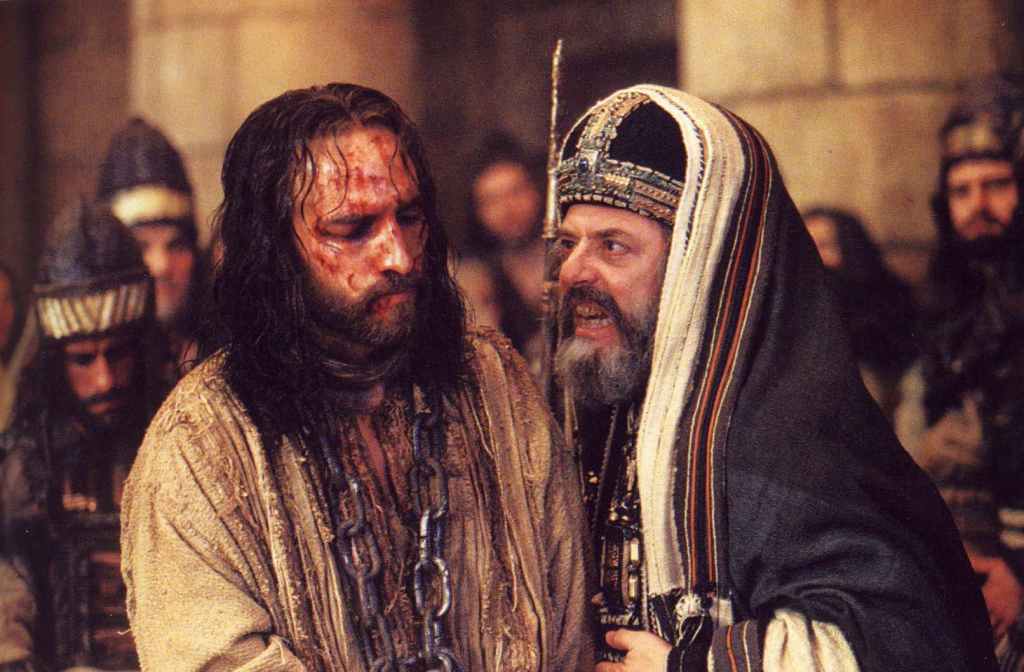
associates the Jewish priests with money (only disparagingly; they do not take the money that Judas throws back at them but, in Mark, the priests do and say, “‘It is against the law to put this into the treasury, since it is blood money.’ So they decided to use the money to buy the potter’s field as a burial place for foreigners” (27:6-7)). It shows Jews demanding Christ’s death—one of the Jewish leaders mocks Christ while he’s on the cross. And Gibson includes Christ’s words to Pilate (John 19:11), implicating the Jewish high priest Caiaphas—the rendering here is “‘it is he who delivered me to you who has the greater sin.’” After the first hour of showing the Jews’ blood libel, the only mention of “Jew”, when Simon of Cyrene—helping Christ bear his cross only after telling lookers-on that he isn’t a condemned criminal himself—is derisively called one by a Roman soldier, seems a clear sop to politically-sensitive critics.
As propaganda—a channeled, controlled, myopic interpretation of events meant to sway an audience into believing a certain “truth”—The Passion of the Christ runs counter to the Bible, which subjectifies and complicates truth by offering four versions of Christ’s life and death in Matthew, Mark, Luke, and John. Gibson’s version of Christ’s betrayal and suffering is explicit, unthoughtful, and bloodily declaiming one fixed “truth”: Jews feared, reviled, and condemned Jesus, who then suffered horrifically. Two years after the movie’s release, when pulled over for speeding in Malibu, Gibson declared to one of the police officers, “Fucking Jews . . . The Jews are responsible for all the wars in the world . . . Are you a Jew?”.
While The Passion of the Christ was controversial on its release, with some groups and academics criticizing its anti-Semitism (and the movie depicts Herod as a roly-poly, mincing, wigged orgiast), it was such a colossal money-maker by Easter, even in some of the Middle East countries where it wasn’t banned, that Hollywood moguls were talking about “faith-based” films as the next great wave. For those roadside comments in July 2006, though, Gibson was exiled to Tinseltown’s wilderness. And yet his directorial comeback, a decade later, was stamped by the same propaganda-template as his religious screed, generated no controversy, received some critical praise, and even garnered six Academy Award nominations (winning two), including one for Best Picture.
In Hacksaw Ridge (2016), Gibson again follows a braveheart-warrior passion-play formula. Again, guts and gore glorify a saintly, self-sacrificing hero, only this time “Japs” are vilified. The nailing of Christ, dislocated arm and all, to his cross was shown in all its frieze-frame, nauseating, gory glory; the World War II movie’s first half is rife with tableaux and slo-mo, meant to engrave in our visual cortexes Desmond Doss’ (Andrew Garfield) seriousness of moral purpose and latent heroism. He has a quasi-revelation about pacifism; he glimpses his higher purpose as a medic and first beholds his true love, a nurse, at the same time; this Seventh-Day Adventist endures Christ-like trials and tribulations at boot camp, climaxing in a court-martial (where he’s saved by his father, arriving deus ex machina).
The Biblical epic offered slo-mo shots of Christ flagellated 32 times by switches and then his flesh ripped by barbed whips; the camera lingers over the criss-crosses seared onto his body and the crimson spray and pools of scarlet ribboned on the ground around the post which Jesus has gripped while brutalized; Gibson recreates

John’s bloody version of the post-crucifixion Christ, with a fearful Roman soldier piercing the dead man’s side with a spear to release a pseudo-baptismal fount of blood and water. It’s martyr-porn, where Christ’s so exsanguinated that even his eyes are bloodshot. The war epic offers a hellish assault, during the Battle of Okinawa, riddled with brutality—shot-through faces, intestines hanging out, body parts flying—and intended
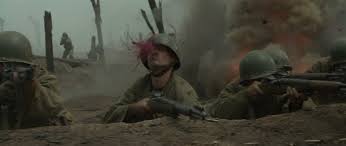
to shock and awe and ultimately consecrate Doss’ bravery. The Japanese swarm up from underground like rats or advance like a demonic horde. Some later wave the white flag, but it’s a ruse (those “Nips” don’t fight fair, boys!); one’s shown strangely committing harakiri and getting decapitated by a subordinate (they won’t

even die like us, boys!). Meanwhile,Doss has saved dozens of wounded (and one Japanese) on his own, lowering them to safety—it’s “a miracle” and all those heretical recruits who spurned him become comrades beholding him now with reverence. A sunlit baptized-by-battle image is soon followed by a shot of Doss on a stretcher that makes it seem as if he’s ascending to Heaven. Thus, beatified and blessed by the camera, Doss is another holier-than-thou hero in another of Gibson’s violence-as-a-means-to-salvation big-screen sermons.
But each and every one of these four vile movies is wedded to a narrative of suffering and salvation (“20 years after the war, 16 years after the German suffering, 19 months after the rebirth . . .”). In Griffith’s and Riefenstahl’s films, too, the (Klan and Nazi) warrior-hero’s righteousness is consecrated by fire, blood, and embattled toughness. All are preoccupied with descent and ascent: the South’s humiliation and the rise of uppity Negroes vs. the triumphant resurgence of the South thanks to the KKK; the descent of God-like Hitler on Nuremberg to make the annunciation of Germany’s glorious rise; Christ’s betrayal and suffering for all of us fallen sinners before he ascends to his father’s kingdom; Doss’ rise from distrusted soldier to hallowed comrade and battlefield-hero.
Yet these four entries in the Movie Hall of Infamy don’t stand alone. The sheer bigotry of these works can be seen in other barnstorming blockbusters, albeit to a lesser degree: James Cameron’s True Lies, with its cartoon-villain Arabs and dismal sexism; the class-fantasy, epic mush of Titanic; jingoistic Uncle Sam ads like Top Gun or Pearl Harbor. So why don’t these marquee movies’ laziness, offensiveness, even hatefulness, condemn them to Never-Never-Watch Land?
Perhaps there’s something about the visual-concreteness of film images that makes it easier to set stereotypes in stone, as if etching commanding figures into a tablet. “It’s like writing history with lightning,” said President Woodrow Wilson of Griffith’s epic after a special White House screening in February 1915. Riefenstahl’s fascism-glorification offers many a recurring, graven image, from standards and swastikas to a sun-lit eagle and its own title in steel-like letters. Gibson’s dogmatic duology offers pre-formed archetypes, each character epitomizing an emotion or reaction (the Jewish high priests embody anger, Judas personifies guilt, Barabbas is a Manson-like psycho, Mary exudes maternal grief, Christ is beatific, Doss remains quietly persistent, the Japanese are villainous Others, etc.).
Griffith’s movie set the template for big-screen mythic propaganda propelled by stock storylines and cardboard-cutout heroes; that easy appeal abides, apparently. But it may also be that the self-conscious importance—read: grandeur and epic-ness—of many of these movies is itself a big part of the problem. It’s as if the graveness and greatness of the movie’s subject-turned-mission should be respected, stamping what’s on screen with respectability. (Jackson’s Tolkien adaptations and the recent spate of comic-book movies have only made for even more self-serious mythologizing in cineplexes in these days of epic blockbustering and blustering.)
There’s also a common misunderstanding about what makes a film offensive or disgusting. Horror flicks or scenes of extreme violence, for instance, are often seen as offensive, disgusting, even controversial. But a movie’s ideology isn’t considered as violent or offensive or even, usually, worthy of much post-viewing discussion or debate. Despite auteur-theory and film studies trying to re-view subtext and much cinema as art, Hollywood’s longstanding showtime-promotion of movies as mere entertainment persists, making it easier for studio-products to mask their messages and for audiences to take images at face-value (even expressing more concerns about casting than content), not dig the depths for meaning. The greater illusion of personalized choice, nowadays via Netflix and other streaming services, only adds to a sense of what-I-want rather than a concern with what-they’re-saying.
And, of course, the monolithic ideology looming over all mainstream-moviemaking is capitalism—no industry tracks its profits more quickly, with the opening weekend now all-important for major studio releases. With all the film-trade markets, trailers, tie-ins, on-screen product placements, spin-offs, brand-building, or franchise-extensions bombarding our viewer-demographic eyes and pounding our consumer ears, the bottom-line between craft and crafty propaganda (aka advertising) has been blurred so much, it sometimes seems like a strange, secular miracle that we can even see through to the art of it anymore.
Works Cited
The Birth of a Nation. Directed by D. W. Griffith, Epoch, 1915.
Brooks, Xan. “The Birth of a Nation: A Gripping Masterpiece … and a Stain on History.” The Guardian, 29 July 2013, https://www.theguardian.com/film/filmblog/2013/jul/29/birth-of-a-nation-dw-griffith-masterpiece.
Hacksaw Ridge. Directed by Mel Gibson, Summit, 2016.
Lynskey, Dorian. “‘A Public Menace’: How the Fight to Ban The Birth of a Nation Shaped the Nascent Civil Rights Movement.” Slate, 31 Mar. 2015, https://slate.com/culture/2015/03/the-birth-of-a-nation-how-the-fight-to-censor-d-w-griffiths-film-shaped-american-history.html
The Passion of the Christ. Directed by Mel Gibson, Icon, 2004.
Triumph of the Will. Directed by Leni Riefenstahl, Universum Film AG, 1935.
The author, a professor of film studies, has written and published this blog post for educational, critical, and analytical purposes. All film stills are included only to bolster the post’s argument and to further its educational purpose.


 Fritz Lang's Crotch Shot (and other film essays you never thought you'd want to read)