Great Films of the 2010s

This list is based on my work this decade—reviewing 80-120 movies annually and Best-of-the-Year lists, 2010-18—as a critic for Vue Weekly. (Bonus at end: Best TV of the 2010s.)

1. The Act of Killing (dir. Joshua Oppenheimer; Norway, Denmark, UK, 2012) and The Look of Silence (Joshua Oppenheimer; Denmark, Finland, France, et al., 2014)

3. The Tree of Life (Terrence Malick; USA, 2011)

4. A Separation (Asghar Farhadi; Iran, 2011)

5. Under The Skin (Jonathan Glazer; UK, 2014)

6. Once Upon A Time in Anatolia (Nuri Bilge Ceylan; Turkey, 2011)

7. 12 Years A Slave (Steve McQueen; UK, US, 2013)

8. Cold War (Pawel Pawlikowski; Poland, 2018)

9. The Missing Picture (Rithy Panh; France, Cambodia, 2013)

10. Blue Is The Warmest Colour (Abdellatif Kechiche; France, 2013) and Ida (Pawel Pawlikowski; Poland, 2013) and Carol (Todd Haynes; USA, 2015)

The Act of Killing

13. Beasts of the Southern Wild (Benh Zeitlin; USA, 2012)

14. Leviathan (Andrey Zvyagintsev; Russia, 2014)

15. Moonlight (Barry Jenkins; USA, 2016)

16. Son of Saul (László Nemes; Hungary, 2015)

17. You Were Never Really Here (Lynne Ramsay; UK, USA, France, 2017)

18. Portrait of a Lady on Fire (Céline Sciamma; France, 2019)

19. Two Days, One Night (Jean-Pierre and Luc Dardenne; Belgium, France, Italy, 2014)

20. A Prophet (Jacques Audiard; France, 2009*) and The Master (Paul Thomas Anderson; USA, 2012)

*not widely released in Canada, the USA, and the UK until 2010

You Were Never Really Here

22. Toni Erdmann (Maren Ade; Germany, Austria, 2016)

23. Nebraska (Alexander Payne; USA, 2013)

24. Parasite (Bong Joon-ho; South Korea, 2019)

25. Phantom Thread (Paul Thomas Anderson; USA, 2017)

26. Call Me By Your Name (Luca Guadagnino; Italy, France, et al., 2017)

27. Manchester by the Sea (Kenneth Lonergan; USA, 2016)

28. Phoenix (Christian Petzold; Germany, 2014)

29. Poetry (Lee Chang-dong; South Korea, 2010) and Secret Sunshine (Lee Chang-dong; South Korea, 2007*) and Burning (Lee Chang-dong; South Korea, 2018)

*not widely released in the USA until 2010 and then available online, etc., after that

Nebraska

32. For Sama (Waad Al-Kateab and Edward Watts; Syria/UK/USA, 2019)

33. Shoplifters (Hirokazu Kore-eda; Japan, 2018)

34. Sweet Country (Warwick Thornton; Australia, 2017)

35. 45 Years (Andrew Haigh; UK, 2015)

36. The Tale of the Princess Kaguya (Isao Takahata; Japan, 2013)

37. Paterson (Jim Jarmusch; USA, Germany, France, 2016)

38. Holy Motors (Leos Carax; France, Germany, 2012)

39. Nostalgia For The Light (Patricio Guzmán; France, Chile, Germany, et al., 2010) and The Pearl Button (Patricio Guzmán; Chile, 2015) and The Cordillera of Dreams (Patricio Guzmán; France, Chile, 2019)

Sweet Country

42. City of Ghosts (Matthew Heineman; USA, 2017)

43. Exit Through The Gift Shop (Banksy; UK, 2010)

44. The Social Network (David Fincher; USA, 2010)

45. Young Ahmed (Jean-Pierre and Luc Dardenne; Belgium, France, 2019)

46. Toy Story 3 (Lee Unkrich; USA, 2010)

47. Dogtooth (Yorgos Lanthimos; Greece, 2009*)

*not widely released in Canada, the USA, and UK until 2010-11

48. The Great Beauty (Paolo Sorrentino; Italy, France, 2013)

49. Dogman (Matteo Garrone; Italy, 2018)

50. Lady Bird (Greta Gerwig; USA, 2017)

Exit Through The Gift Shop

51. Martha Marcy May Marlene (Sean Durkin; USA, 2011) and Sun Don’t Shine (Amy Seimetz; USA, 2012)

53. Certified Copy (Abbas Kiarostami; France, Iran, 2010)

54. These Birds Walk (Omar Mullick and Bassam Tariq; USA, 2013)

55. Loveless (Andrey Zvyagintsev; Russia, 2014)

56. Hereditary (Ari Aster; USA, 2018)

57. Hugo (Martin Scorsese; USA, 2011)

58. Two-Legged Horse (Samira Makhmalbaf; Iran, Afghanistan, 2008*)

*not widely released; only available online, etc., in the 2010s

59. Tower (Keith Maitland; USA, 2016)

60. Beyond The Hills (Cristian Mungiu; Romania, 2012)

Two-Legged Horse

61. Lady Macbeth (William Oldroyd; UK, 2016)

62. Moonrise Kingdom (Wes Anderson; USA, 2012)

63. Amour (Michael Haneke; France, Germany, Austria, 2012)

64. Dreamcatcher (Kim Longinotto; UK, USA, 2015)

65. The Invisible War (Kirby Dick; USA, 2012)

66. Upstream Colour (Shane Carruth; USA, 2013)

67. The Florida Project (Sean Baker; USA, 2017)

68. Elena (Andrey Zvyagintsev; Russia, 2011)

69. Rebelle (War Witch) (Kim Nguyen; Canada, 2012)

70. Beast (Michael Pearce; UK, 2017)

Elena

71. A Ghost Story (David Lowery; USA, 2017)

72. Under The Shadow (Babak Anvari; UK, Jordan, Qatar, 2016)

73. The Illusionist (Sylvain Chomet; France, UK, 2010)

74. Taxi (Jafar Panahi; Iran, 2015)

75. Only The Young (Elizabeth Mims and Jason Tippet; USA, 2012) and Winter’s Bone (Debra Granik; USA, 2010)

77. Neighboring Sounds (Kleber Mendonça Filho; Brazil, 2012)

78. The VVitch: A New-England Folktale (Robert Eggers; USA, Canada, 2015)

79. Foxtrot (Samuel Maoz; Israel, 2017)

80. This Is Martin Bonner (Chad Hartigan; USA, 2013)

The Illusionist

81. She Monkeys (Lisa Aschan; Sweden, 2011) and The Diary of a Teenage Girl (Marielle Heller; USA, 2015)

83. Mother (Bong Joon-ho; South Korea, 2009*)

* not released in Canada, USA, and the UK until 2010

84. Of Gods and Men (Xavier Beauvois; France, 2010)

85. The Levelling (Hope Dickson Leach; UK, 2016)

86. The Grand Budapest Hotel (Wes Anderson; USA, 2014)

87. The Wolf of Wall Street (Martin Scorsese; USA, 2013)

88. Le Quattro Volte (Michelangelo Frammartino; Italy, Germany, Switzerland, 2010) and Happy as Lazarro (Alice Rohrwacher; Italy, 2018)

90. Boy and the World (Alê Ambreu; Brazil, 2013)

She Monkeys

91. The Red Turtle (Michaël Dudok de Wit; France, Belgium, Japan, Germany, 2016)

92. The Irishman (Martin Scorsese; USA, 2019)

93. Meek’s Cutoff (Kelly Reichardt; USA, 2010)

94. Blade Runner 2049 (Denis Villeneuve; USA, 2017)

95. The Deep Blue Sea (Terence Davies; UK, 2011)

96. Custody (Xavier Legrand; France, 2017)

97. The Kid with a Bike (Jean-Pierre and Luc Dardenne; Belgium, 2011)

98. Monos (Alejandro Landes; Colombia, 2019)

99. The Wolfpack (Crystal Moselle; USA, 2015)

100. Ernest & Celestine (Stéphane Aubier, Vincent Patar, and Benjamin Renner; Belgium, France, Luxembourg, 2012)

Custody

101. The Selfish Giant (Clio Barnard; UK, 2013)

102. The Overnighters (Jesse Moss; USA, 2014)

103. Submarine (Richard Ayoade; UK, USA, 2010)

104. NEDS (Peter Mullan; UK, France, Italy, 2010)

105. Le Havre (Aki Kaurismäki; Finland, 2011)

106. Inside Llewyn Davis (Joel Coen and Ethan Coen; USA, France, 2013) and Searching For Sugar Man (Malik Bendjelloul; Sweden, UK, Finland, 2012)

108. Mad Max: Fury Road (George Miller; Australia, USA, 2015)

109. The Lighthouse (Robert Eggers; USA, 2019)

110. It Follows (David Robert Mitchell; USA, 2014)

The Lighthouse

111. Dreams of a Life (Carol Morley; UK, 2011)

112. Arrival (Denis Villeneuve; USA, 2016)

113. Snowpiercer (Bong Joon-ho; South Korea, 2013)

114. Ixcanul (Jayro Bustamante; Guatemala, France, 2015)

115. Citizenfour (Laura Poitras; Germany, USA, 2014)

BEST TV OF THE 2010s

1. The Leftovers (Damon Lindelof; HBO, 2014-17)

2. Chernobyl (Craig Mazin; HBO/Sky, 2019)

3. Breaking Bad (Vince Gilligan; AMC, 2008-13)

4. Boardwalk Empire (Terence Winter and Howard Korder; HBO, 2010-14)

5. The Virtues (Shane Meadows; Channel 4, 2019)

6. This Is England ’86 (Shane Meadows; BBC, 2010)

7. Happy Valley (Sally Wainwright; BBC, 2014- )

8. The Hour (Abi Morgan; BBC, 2011-12)

9. Mildred Pierce (Todd Haynes; HBO, 2011)

10. Burning Bush (Agnieszka Holland; HBO Europe, 2013)

Description: mage result for the virtues


That’s A Wrap

Terry Gilliam’s Brazil (1985) is a Christmas-dystopia movie. It’s as if the Python animator took the musical finale in Monty Python’s The Meaning of Life (1983)—a Tony Bennett-like singer, surrounded by topless Snow White dancers, croons, “It’s Christmas, it’s Christmas in Heaven . . . Hip hip hip hip hip hoo-ray / Every single day / Is Christmas Day”—and nosedived that Xmas-vision into Yuletide hellfire, but made sure to wrap the plummeting spectacle in darkly glittering fantasies, dream-visions, and hallucinations.

The sleigh-ride down the cosmetic surface of things begins with a descent from the clouds to a show-window, wrapped in tinsel, where display TVs broadcast a man talking about that convoluted network which wraps itself all around this Central Service-run society: “ducts” (an eerie foreshadowing of the Internet’s dominance of our lives, with its vast network of tubes, cables, and servers conducting virtual-reality power to our show Windows and Apple TVs). The façade shatters, as a man pushing a shopping cart full of wrapped presents passes by, when a bomb goes off; over and over,

wrappings are torn and the bubble of this empty consumerist society seems to burst. But the wrapping itself is the delusion—the film’s showy title, glowing in red-and-blue neon, refers to Ary Barroso’s 1939 exaltation-samba “Aquarela do Brasil” (known as “Brazil”), played ironically and central to the film’s score. Just how vastly that wallpapering delusion extends, though, isn’t so clear until the film’s disturbing ending.

This 1984-meets-British (red-tape-bordering on Soviet; an Odessa Steps sequence, from Battleship Potemkin, hammers home the sickle-point) bureaucracy world’s wrapped in paper. Typewriters—one of many retro-futuristic machines, often going on the fritz, which decorate this land’s apartment-blocks and office-towers—disgorge reams in the office where “Tuttle” fatefully becomes “Buttle” in a SNAFU (Situation Normal All Flied Up—a buzzing insect becomes a bug in the system after it’s swatted, falling into a machine and glitching a T into a B). Paper decorations and streamers festoon the flat, snaked through with ducts, where Buttle’s family is

besieged by stormtrooper-like officers and the man’s seized by the authorities. The arrest process is all coldly wrapped up with his wife’s compelled signature on a paper form. Such mangled, wrangled wrapping for files and records churns on and on through this paper-pushing world, where everyone seems bundled up in a uniform.

Clerk Sam Lowry (Jonathan Pryce), bored witless by his job in the Records Department, wraps up the tedium of his life in Christmas-like fantasy. When we first see him, he’s like a treetop-angel come to life, crossed with Icarus and a glam-rocker, and gliding about on shining silver wings, looking to save a woman—herself first seen, up in the clouds, wrapped in a diaphanous, breeze-ruffled fabric—who, he soon realizes, resembles Jill Layton (Kim Greist), trying to retrace the paper-form trail and clear up the error which led to her neighbour Buttle’s arrest. But it becomes shimmeringly clear, from the real Harry Tuttle’s (Robert De Niro) convenient, pop-up rescues of Sam to Sam’s pursuit of the faintly remote, removed Jill, that Sam’s life may be mostly enveloped by delusion. He’s little different from the Deputy Minister of Information, wrapping his words in cricket metaphors, or his mother, saran-wrapped by her plastic surgeon (high-society women tend to be packaged beneath preposterous fascinators or coiffures, warmed by fur wraps, or swaddled in post-op bandages). And,

in a self-questioning move that interrogates the purpose of movies themselves—illusory escape or artistic provocation?—Gilliam wraps his film in delusions of grandeur.

Teamed up with his usual cinematographer of the era, Roger Pratt (whose work on the Monty Python short “The Crimson Permanent Assurance” is echoed here in the dream-sequences of heroism amid gargantuan buildings, shooting up and stretching out), Gilliam goes gonzo with German-Expressionism, taking his cues from Fritz Lang’s Metropolis (1927) but finding even more startling, striking angles for most shots, many of them also wildly wide-angle. Sets, with their long shadows, high pillars, and towering walls, recall art-deco, Bauhaus, and brutalist styles. Uncredited writer Charles Alverson, co-writers Tom Stoppard and Charles McKeown, and Gilliam garland this film-noir with references to Orwell’s famous book (one of the film’s working titles was 1984 ½): a mysterious war against terrorists has been going on for 13 years; Ministry of Information slogans abound: “Loose talk is noose talk”; “Suspicion breeds confidence”; “We’re all in it together”; Sam’s torture is reminiscent of Winston’s. As Sam suspiciously eyes Jill’s brown paper-wrapped parcel on the seat between them, the highway’s lined on both sides by Potemkin-like billboards, screening from drivers’ view the plundered, desolate landscape stretching

off into the horizon. (Here and elsewhere, the vistas, like Sam’s surname, evoke L. S. Lowry’s paintings of Lancashire and Salford-area industrial landscapes.) And Sam’s world is itself wrapped in televisual-images: office-workers tune out at their stations in order to tune in to old movies on their screens; guards monitor surveillance-cameras trained on lobbies. Sam’s apartment is decorated with film posters and he quotes a line from Casablanca.

It’s as if, Gilliam warns us, in this film set “somewhere in the 20th century,” we’re already wrapping ourselves in the pre-packaged delusions of films past, products present, and fantasies future, not so much consuming as consumed by unoriginal, manufactured dreams and desires. All that wrapping can be trapping—the packaging can contain us, just like Sam, left after his torture to descend into his daydreams. Those dreams of heroic action (saving the damsel, fighting the samurai, breaking out of the torture-chamber), much like Gilliam’s Brazil, involve elaborate, operatic reworkings of movie tropes and references, a mental gauze which Sam winds around and around himself to flimsily paper over the wounds and traumas of his torment. But we can’t even escape with him—not long after the imprisoned Sam talks to a Santa-capped Deputy Minister in a padded-wall room, the last

shot, of him left alone post-torture, arrives. And it leaves us with only the vast, grey, filing cabinet-like walls encircling Sam, containing him at film’s end, before that exaltation-samba plays on and on over the final credits, ever so sardonically, a muzak-Möbius strip. Play it again and again and again, Sam . . .

Works Cited

Brazil. Directed by Terry Gilliam, Universal, 1985.

The Crimson Permanent Assurance. Directed by Terry Gilliam, Universal, 1983. [17-minute short played before The Meaning of Life.]

[Monty Python’s] The Meaning of Life. Directed by Terry Jones, Universal, 1983.

The author, a professor of film studies, has written and published this blog post for educational, critical, and analytical purposes. All film stills are included only to bolster the post’s argument and to further its educational purpose.

Paulette Goddard’s Teeth, Anne Hathaway’s Breasts

One of the most fearsome, fiercely feminist moments in film comes 20 minutes into Chaplin’s Modern Times (1936). Until then, it’s been a man’s world—the assembly-line at the Tramp’s factory, gloweringly overseen by a boss who even appears on a screen in the bathroom to bark at the smoking Factory Worker/Tramp, “Get back to work!”.

So it’s a slight shock to shift gears from men’s deadening production-line labour to a woman on the waterfront. And not just a woman, but the film’s most formidable outsider—“who refuses to go hungry”—even more desperate, energetic, and defiantly hopeful at times than the Tramp himself. We first see her defined not by emotion but by action—her hand, holding a knife, saws away at a clump of bananas in a ship’s basket, down by the water. And then we first behold Paulette Goddard’s Gamine looking up and around, not alarmed but almost daring anyone to stop her. She tosses the

bananas up to other needy kids on the wharf as she clenches a knife between her teeth, eyes flashing as she taunts those who’d stop her stealing bananas to feed her family. She’s part-primate, part-pirate and altogether an ever-moving, flouncing, mischievous, rebellious force.

Her grin is gleeful, daring, displaying a brilliant smile that’s winning—you can see immediately why the Tramp would be attracted to her, not as potential soulmate but as kindred spirit—and sharply, delightfully disobedient. But most of all, it’s practical—her glinting teeth hold the knife there and seem to anticipate biting into the food she’s desperate for. Spotted by a dockworker, she scampers away, across some other boats, clambers onto shore, and then turns, plants her feet apart, and defiantly peels a banana, making ready to eat one of her illicit gains as the camera closes in

on her. Her eyes narrow, she tosses her head back once, and she begins to eat. In only her second credited film role, the New York City-born Goddard sparks the Gamine to roaring, riotous, roisterous life; our first look at her is, really, all about her first look, past us, defying authority and control, overawing the camera. And, even more subversively and joyfully, by film’s end, we’re left with the Tramp and Gamine’s bright, free, spirited bodies prevailing over the factory’s cold, slavish, tick-tock metal machinations.

Smash-cut, nearly three-quarters of a century on—after, in the US, the pill, second-wave feminism, anti-porn arguments, Steinem and Wolf, Stonewall, riot grrls, third-wave feminism—to Love & Other Drugs (2010). Maggie Murdock was already New York City-born Anne Hathaway’s eighteenth credited movie role. A romantic-comedy that could have satirized the pharmaceutical industry—it’s based on Jamie Reidy’s memoir Hard Sell: The Evolution of a Viagra Salesman—Edward Zwick’s movie instead remains in the narcotizing world of men’s work, then lapses into looking-as-leering, using the camera to channel a scuzzy, odious male voyeurism the first time we see Maggie. While Goddard’s unnamed character explodes the Gamine type in just her first scene, Hathaway’s Maggie is reduced by the movie to that eccentric, girlish object of desire—the Manic Pixie Dream Girl. It’s the late ’90s and Jamie Randall (Jake Gyllenhaal) is part salesman but, randy, all ladies’ man—he even has sex with his co-worker’s girlfriend in the backroom of the electronics store where he works and, while leaving after they’ve been caught, hits on another female customer happy to give him her number. Becoming a pharmaceutical-rep for Pfizer (yep, he sleeps with his sales-coach), he accosts doctors on their way into their offices. He sweet-talks a receptionist, sleeps with another one, and steals a competing rep’s samples, leaving them in a dumpster (in what’s meant as an amusing side-gag, a tramp keeps retrieving them for himself). Jamie’s grin is all devilish and slick, yet he’s the protagonist, meant to have our sympathy as he channels our gaze. And then the camera, already aligned with smug, smarmy Jamie, accosts a patient.

The patient’s Maggie, who appears 20 minutes into the movie. She’s a 26-year-old Parkinson’s sufferer waiting in Dr. Knight’s office; Jamie, shadowing the medical man after he’s paid him to do so, is passed off by the shrugging Knight as an “intern”. She needs more “meds”, dryly listing off the four different drugs she takes and how many times a day; Jamie responds with a brief pitch for Zoloft. Her gallows humour’s only meant to solicit our empathy all the more, but then she asks the doctor to take a look at the “weird blotch” on her breast. It’s a moment of necessary, clinical nudity—a patient’s revealing a normally covered part of herself, purely out of health concerns, to a physician. Yet the dialogue emphasizes the voyeurism: “Well, let’s have a look”; “Do you see that?” And, sure enough, Zwick & Co., refusing to shoot the moment from behind Maggie’s shoulder or from the neck up or in any other privacy-respecting way, show us—in an era of screen-captures, nudity-clip databases, and much more out there covering what’s less—Maggie/Hathaway’s left breast, savagely sexualized. Dr. Knight assesses her, Jamie looks on, mouth open, and we’re left to stare, too. Jamie’s got a glint in his eye and that seductive smile on his face again. (Maggie catches him out right afterwards, in the parking lot, and whacks him, but that’s understood to be this budding romance’s fiery misunderstanding, before these two, seemingly at odds, end up in bed together . . . and so it comes to pass.) A rom-com’s meet-cute is turned prurient, scuzzy, and lecherous. Goddard’s gamine is charmingly insolent, meeting our look with a defiant one of her own; Hathaway’s patient is submissive, a pleasing vacuity for us to fill in with our stare, channelled through Jamie and projecting desire. It’s the men’s collective, targeting look that matters, a lustful male gaze that, it’s assumed, the entire audience shares. Voyeurism’s the ultimate drug here.

And so, decades after Goddard’s teeth offer an unforgettable glint of female rebelliousness, a mesmerizing flash of women staring so dissentingly back, popular American films can still regress so basely, relapsing into sexist titillation. It’s enough to make you wonder if movies really do reflect the progress out there, in the non-reel world, or if so many of them just can’t kick their addiction to the bottom-line.

Works Cited

Love & Other Drugs. Directed by Edward Zwick, 20th Century Fox, 2010.

Modern Times. Directed by Charlie Chaplin, United Artists, 1936.

The author, a professor of film studies, has written and published this blog post for educational, critical, and analytical purposes. All film stills are included only to bolster the post’s argument and to further its educational purpose.

Mirror, Mirror on the Wall (and in the Hall)

The creature-feature horror with ghosts or vampires often relies on what you so nearly, almost, but can’t quite yet see . . . only you know it’s coming. Legend has it that neither apparition nor bloodsucker can be captured in a mirror (though it can be regularly caught on camera, apparently—Dracula’s the most-filmed non-human character); the serial-killer flick, however, derives much of its chilling fascination from the extremity of what we all know is coming. It’s existentialism at its most brutal and death at its annihilating worst—the sense that some murderers’ victims just vanish. Like a thing discarded or dismembered or dumped, the body’s simply erased, perhaps not unearthed again or, if so, forever, horribly changed—a grotesque mockery of a person once so alive. But two classics of the sub-genre, nearly a half-century apart, remind us the camera-lens can do more than just reflect our post-industrial, post-God dread of being rendered, suddenly, into non-being. Cinema’s onlooking-glass can also reflect the monstrous erasure of the victim and the replacement of the victim by the egotistical murderer himself—a nothing or nobody, seemingly incapable of self-reflection, who’s elevated into horrible notoriety for his inhumanity.

In David Fincher’s Zodiac (2007)—based on the 1968-69 Bay Area killings and one man’s investigation of them—even the name of the unknown killer looms over all, there in the title. His identity obsesses newspaper cartoonist Robert Graysmith (Jake Gyllenhaal), as if it’s a puzzle to be solved or a code to crack (the killer sends cipher-messages and cryptograms to the press). Years later, following a film-related lead, Graysmith meets a man, Bob Vaughn (Charles Fleischer), who pulls up outside a theatre marquee. It’s a California noir-meets-Gothic scene—a dark sedan, night-time, rain, a private investigator, soon an old wooden house—but it’s the low angles, amped-up ambient noise (the loudness of the rain, the footfalls and creaks in a basement, the depth of awkward silences) and the unsettling mini-lapses in point-of-view (on occasion, we don’t see what Graysmith does until moments later or we see what Graysmith will moments before he does) which make it the film’s creepiest and eeriest sequence. It’s also a sequence dominated by tightly-controlled images and by let-loose imagination.

As Graysmith talks to Vaughn through the only half-opened glass of his passenger-side car-window, the man—an organist for a movie theatre, we soon learn—is mostly obscured by shadow. The older man’s mastery of the situation and steady, assured tone (Fleischer’s known for his voice-work,

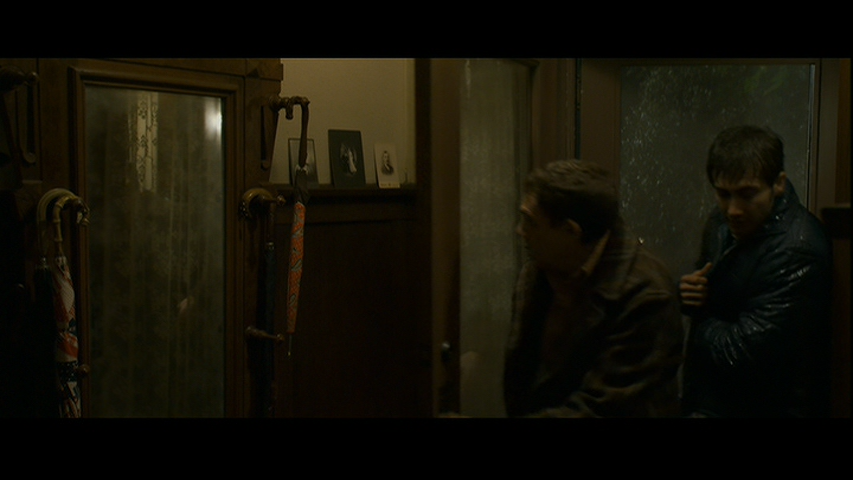
especially as the title character in 1988 animated noir Who Framed Roger Rabbit?) alarmingly contrasts with Graysmith’s youthful naïveté as he agrees to go to his place. When we reach Vaughn’s house, though, we don’t follow them but enter first. The camera’s already inside, framing a wooden hall-closet with a full-length mirror on its door and the front door itself, opening now to admit Vaughn and his guest, both of them briefly reflected in the mirror. (Other details are slightly unsettling: there are four umbrellas hanging up, yet Vaughn didn’t take one with him on such a rainy evening; what exactly are those three old photographs on the mantle by the mirror?)

Image, imagination, and the immediate here-and-now quickly blur. After Graysmith asks Vaughn about his theatre’s projectionist, in 1969, of The Most Dangerous Game (1932), about a man hunting humans for sport, Vaughn notes that the target-like mark at the start of reels looks much like the Zodiac’s infamous signature to his letters. After Graysmith wonders about the projectionist’s writing on the film posters, which seems similar to the Zodiac’s, Vaughn tells him that he himself did all the posters. By the time they descend to Vaughn’s dark, cramped basement, Graysmith (“Not many people have basements in California”) feels he’s being hunted. (The moment’s also a metaphor for Graysmith’s obsession—even fearing the worst, he can’t help but follow Vaughn downstairs, on the off-chance he’ll be one turn closer, in this labyrinth, to confronting the Zodiac.) He panics and leaves in a rush, returning the way he came—as the teapot, no longer a harbinger of hospitality, comes to an ominous boil—and runs to the front door, where he rattles the lock, trying to leave. The camera now shows him side-on, that hall-closet mirror behind him, and Graysmith’s eyes are almost out of the frame (breaking the “rule of thirds”), staring up—presumably to see if the door’s somehow locked at the top, but it’s as if he’s seeking heavenly intervention. And so, right then, when Vaughn’s reflection only appears in the mirror, so suddenly, right behind Graysmith, it’s not just

 uncanny. It’s as if image and imagination (movie and movie-inspired fear), melding into one, have at last overtaken not only Graysmith but us, too.

Graysmith’s dread is channeling ours as we identify with this amateur detective, and it’s a self-conscious, post-modern, film-savvy dread. We know the slasher movies and serial-killer flicks and recognize their usual-suspect sequences (odd house, dark basement, creepy stranger), but it’s exactly our knowledge of those conventions that gives Graysmith’s and our dread weight—just because it only seems to happen in those earlier, more pulpy films doesn’t mean it can’t happen right here and now in this one, does it? Is this the moment the serial killer reveals himself? And what lies at the uneasy, quickening heart of it all is the film which killed off a central character long before the end, brought about the slasher and serial-killer subgenres, and launched more than a million fears of dark basements and curtained showers—another California thriller whose title proclaims the murderer in its misty midst: Psycho (1960). 

Mirrors are a recurring motif in Hitchcock’s film. They reflect back, film screen-like, flickers: of selves split by geography and circumstance (Marion and Sam, eager to marry but hobbled by his debts, after their tryst in a hotel room); of self-doubt and self-resolve (Marion looks back from her vanity mirror at the money she’s embezzled—how costly will her act of vanity prove?); of self-incrimination (the suspicious patrol officer’s car in Marion’s rear-view mirror); of split selves (good and bad Marion, in the bathroom mirror at the used-car lot, counting out bills from her envelope of stolen cash). Mirrors help us to identify with but also keep us removed from a character, setting us up all the more for the big shocker 47 minutes in when, as critic Robin Wood has pointed out, this woman-on-the-run with whom audiences have been led to identify is suddenly removed. At the moment when she feels she will come clean, having decided to return to Phoenix and turn herself in, she’s bathed in blood, killed by Norman’s mad mother-figure.

When Marion Crane (Janet Leigh) first enters Norman Bates’ realm, though, not knowing she’s slipping into a psycho’s vortex as she crosses the threshold, her reflection appears first; as in Zodiac, it’s her image, not her true self, which first appears in the office mirror there on the wall, by the counter, when she enters to register as a guest (clutching her black bag, the stolen money inside), Norman (Anthony Perkins) following.

But it’s what happens when Sam and Marion’s look-alike sister Lila (Vera Miles) returns that’s most alarming. (Psycho is a film of stand-ins, from its famous motel set to the doubles for Perkins and Leigh in the shower-scene, shot over six days.)

Sam and Lila, determined to get to the bottom of what happened at the motel, pose as a couple stopping overnight en route to San Francisco; Norman, smiling, his sleeves rolled up, acting carefree, almost has a spring in his step as he enters the office. But then, with an ever-so-slight jolt in pacing and point-in-view that Fincher and his editor Angus Wall would magnify 47 years on, after Norman goes into the office and just as Sam and Lila follow, Hitchcock and his editor George Tomasini cut to a side-on shot of the interior of the office, with Norman moving to the right of the camera—so disturbingly close to us for a moment—and Sam coming into view in the office mirror. He’s replaced Marion as possible victim, but this

time Norman’s led the way, his image not appearing in the mirror (because the cut avoided showing it). And it’s not that Norman’s image can’t appear—he’s not some vampire-like monster; we’re offered an involved psychological explanation of Norman near film’s end—but that we didn’t glimpse it, as if we haven’t yet seen his other self. This Bates-place, or baiting-space, has already hinted at Norman’s predator-ness, though. When the private investigator Arbogast visited to check the register, Norman tilted his head to the side to examine the book, the askew view of his neck and throat and chin making him seem suddenly bird-like—all beak, about to strike, or gizzard, about to devour—as if he’s little different from the winged killers he’s stuffed and mounted throughout the parlour behind the

office. And when Lila sneaks into the house, only to be startled in the bedroom by her own reflection echoing back at her in two mirrors, she’s creeping closer to discovering the grotesque alter ego behind her sister’s

vanishing—Norman recently moved his mother’s skeleton from that room to the basement, as if trying to store the secret deeper in the recesses of his depraved mind.

That alarming, vertigo-like effect Lila feels, standing between two mirrors, is a mise en abyme—“placed into abyss”. That abyss isn’t so much dark and sucking, as with the quagmire behind the motel where Norman dumps Marion’s car, but more white and blinding in Hampton Fancher’s The Minus Man (1999). There, the California-travelling Vann (Owen Wilson), in his mimicry and masquerade of masculinity, becomes a blank slate even to himself, a mirror reflecting nothing back. He’s stuck in a kind of self-blanking loop. The peripatetic Vann kills to “erase the path” his homicidal urge travelled. He kills to deny his desire and sense of self and to keep remaking his desire and sense of self. Stuck in this cycle of erasure and rebirth, he nears his fearful desire for death only to avoid it again through the killing of another. (At film’s end, Vann drives out of town, moving on, only to be followed by a state trooper . . . who soon takes a turn-off, leaving Vann free to kill again; the scene recalls the state trooper’s following of Marion on her drive to Sam in California before he turns off, only to come upon her again at the car dealership, as if her conscience has returned.)

Norman, too, can be reborn as his mother but then, unable to kill her (or his split-self) again, kills another. He’s not just one but two . . . but more people than that that fall prey to his rapacious Oedipal ego-complex.

And so, like a mirror, even as these films seem to edge us nearer to the truth (who’s the Zodiac? who killed Marion?) and the horror, they also push us away. For how can we really enter the basement of a killer’s mind, and what would it achieve? Graysmith’s obsession doesn’t lead to the Zodiac being caught or any “justice”; diagnosing Norman doesn’t return Marion to the picture, putting her back into that mirror-frame. Yet cinema’s fascination with serial killers continues, perhaps because they’re such out-sized, sinister stars of their own show—bloated, scarred, twisted egos ending the lives of others.

Works Cited

The Minus Man. Directed by Hampton Fancher, Artisan/The Shooting Gallery, 1999.

Psycho. Directed by Alfred Hitchcock, Universal, 1960.

Zodiac. Directed by David Fincher, Warner Bros., 2007.

The author, a professor of film studies, has written and published this blog post for educational, critical, and analytical purposes. All film stills are included only to bolster the post’s argument and to further its educational purpose.

Monty Python and the Ire of Zion

Although it looked back almost 2000 years for its comic content, Monty Python’s Life of Brian was nearly a decade ahead of its time in provoking pop-cult Christian controversy. When it hit theatres in August 1979, nine years before twin torrents of holier-than-thou, sacre dieu! outrage—over Scorsese’s The Last Temptation of Christ (released in August 1988) and Madonna’s “Like A Prayer” video (March 1989)—the silly sextet’s Biblical spoof was prohibited by some British town councils, picketed in New York by nuns and rabbis, and banned in Norway and Ireland. But how much hotter would the steaming Pilate of blasphemy-accusations have got if the Pythons had included their scripted mockeries of Zionism?

A zealous Zionist leader of a “thoroughly trained suicide-squad,” Otto (Eric Idle), sporting a thin moustache, a German accent, and a swastika-tipped Star of David on his Pickelhaube-like spiked helmet, talks to mistaken-for-the-Messiah Brian (Graham Chapman) about a long-awaited arrival. In the rough outtake, this Otto-man who otto-matically announces “Hail, leader!” with a “Hail!” salute also declares, “The Leader will save Israel by ridding it of the scum of non-Jewish people, making it pure—no foreigners, no riff-raff, no gypsies.” This policy’s both a sham and self-destructive (the squad fakes mass-suicide, much to their leader’s dismay), blindly pursued, as his troop of supposedly self-stabbing soldiers sings, “There’s a man we call our leader . . . And we follow him un-ques-tio-ning / Towards an early grave . . . And if we’re one of the lucky ones, / We will live to die again.”

The screenplay for the film, which opened five months after the landmark Israel-Egypt peace treaty brokered by Jimmy Carter, had more. The Jewish supremacist’s Hitler-ness was, well, expanded: “We need more living room. We must move into the traditionally Jewish areas of Samaria. . . . we can put [the Samaritans] in little camps. And after Samaria we must move into Jordan and create a great Jewish state that will last a thousand years.” (This also reflects Israel’s settlement-expansion.) Carter has since criticized Israel as an apartheid state for its treatment of Palestinians, but the Pythons aimed further earlier, perhaps riffing off the 1975 UN Resolution declaring Israel’s nationalist ideology “a form of racism”. They draw racial extremism- and purity-parallels between Zionism, which had pushed for a Jewish homeland, and Nazism, whose anti-Semitic genocide ensured that homeland’s formation.

Accounts conflict over why Otto’s appearance was cut, according to the group’s autobiography, The Pythons. Terry Gilliam thought the scene should stay and suspected Idle “got cold feet because he was now living out in Hollywood and he felt the Jewish producers [there] would take great offence”. Idle wonders if theatre-impresario Bernard Delfont pulled funding for the movie at the last minute in large part because of the scene as written in the script. But, post-production, test-screenings apparently confirmed what some other Pythons, including Idle and director Terry Jones, felt—the scene slowed the story. Idle himself notes, though, that “when it opened people were expecting that scene and that’s what they came out angry about.” And historian David Nash, in Blasphemy in the Christian World: A History, claims Otto was crucified “on the cutting-room floor, in the interests of smoothing the way for the film’s distribution in America.”

Works Cited

Cleese, John, Terry Gilliam, Michael Palin, Eric Idle, and Terry Jones. The Pythons: Autobiography by The Pythons. St. Martin’s, 2003.

[Monty Python’s] Life of Brian. Directed by Terry Jones, Orion/Warner Bros., 1979.

Nash, David. Blasphemy in the Christian World. Oxford UP, 2007.

The author, a professor of film studies, has written and published this blog post for educational, critical, and analytical purposes. Images are included only to bolster the post’s argument and to further its educational purpose.

A little Pip-speak, or Great Textpectations

(Note: this is a bonus post . . . about literature, not film.)

“Merry Christmas.” That was the first text message ever sent, in December 1992. Since then, texting and its abbreviated language, “textese,” has been setting up the wheres and whens of going out to do whatever, remote-controlling homes, launching and sinking relationships, and even scandalously ending political careers. Now with group texts, microblogging, and added emojis, texting’s a 21st-century phenomenon, we like to #think. But what if the same man who invented our modern sense of Christmas, in his tale of Scrooge and Tiny Tim, also eerily looked ahead, like a Ghost of Writing Future, to texting as an expression of one’s identity?

Charles Dickens writing at desk (J. Gurney & Son, 1868)

Charles Dickens’s Great Expectations (1861) begins with a little boy starting to gain a sense of himself and his life in a graveyard. The narrator, Philip Pirrip, has already characterized himself as a small seed, not yet developed. When he was young and starting to speak, he gave himself a handle, shortening his full name — as it was easier to say, to sound out, and had a quick, sharp ring to it — to Pip: “So, I called myself Pip, and came to be called Pip.” In the parish cemetery, among his dead family, he forms mis-impressions of what his father, mother, and five little brothers had looked like from not just the shape of their graves but, more so, from the shape of the letters in the inscriptions on the headstones. The boy is bringing them back to life through text.

And Pip is figuring out his tiny place in the world, too, for this first grave memory of his, which he offers for us as text to read through, is of being afraid and crying when he finds himself outdoors, seemingly all alone and exposed to the elements. He is present and yet not — like a writer, putting one’s self out there, on the screen — as he has his “first most vivid and broad impression of the identity of things.” This is when “I found out for certain, that this bleak place overgrown with nettles was the churchyard . . . and that the dark flat wilderness beyond the churchyard . . . was the marshes; and that the low leaden line beyond, was the river; and that the distant savage lair from which the wind was rushing, was the sea; and that the small bundle of shivers growing afraid of it all and beginning to cry, was Pip.”

Another formative moment for young Pip comes when, further gaining a sense of his voice, he forges it into written self-expression for his adoptive father (his sister’s husband) Joe, a blacksmith. Using a tablet-like slate and referring to an alphabet as he takes more than an hour to write a letter to Joe, Pip shapes letters, as if inscribing them on the slate-like board of a headstone, perhaps, and composes this:

You do not have to be fluent in textese, though it helps, to read this message. It says, transliterated into not-quite-“proper” English, “My dear Joe I hope you are quite well I hope I shall soon be able for to teach you Joe and then we shall be so glad and when I am ’prenticed to you Joe what larks and believe me in affection Pip.” There is the textese-like use of numbers, 4 and 2, instead of spelling out those prepositions, and the textese-like use of a letter in place of a word (U for you, R for are, B for be, and even M for am).

Joe is astonished and proud of Pip, thinking him a “‘scholar’”; Joe even manages to recognize his own name and reads it aloud. Pip is not so sure of his own achievement, and thinks of what he has written much as he thought of the landscape around the cemetery, where he first gained an “impression” of himself and his family through reading: he has “a misgiving that the writing was rather hilly.” Pip quickly realizes, though, from Joe’s

Joe Gargery and Pip (Felix O. C. Darley, 1888)

inability to navigate Pip’s textual landscape, that Joe is illiterate; their talk turns to rising in education and station, of which Pip’s sister is distrustful. Pip, however, will later be funded by a mysterious benefactor so that he can become a “‘scholar’” and a gentleman and rise in the world. This text-like message, then, is Pip being honest about how rudimentary his self-education was and showing us that, from the seed of such a basic little letter-writer, he would grow into a well-educated, highly literate young man.

Such progression is eerily predictive, for, less than a decade ago and 150 years after Great Expectations was first published, studies began to allay concerns about what texting and textese is doing to young people’s literacy. Linguistic psychologist Nenagh Kemp notes, in a 2014 article, that then-recent studies suggested that children’s “exposure to ‘textisms’ (the abbreviated spellings of text messages) is actually associated with better literary skills.” A study that she and colleagues at the University of Tasmania conducted “found no evidence that the use of grammatical violations in text messages is consistently related to poorer grammatical or spelling skills in school students.” A 2016 study in the Netherlands concluded: “Not only may textese improve children’s abilities in written language, as has been attested in previous work, [but] it may also enhance their grammar abilities in spoken language as the present study has shown. This clearly refutes the suggestion that use of textese may lead to language deterioration.”

Dickens’s books are rich in dialectical and idiomatic English, and Pip’s text-speak offers a quick primer in linguistic history and language-development, too. We may like to think that human civilization has made a steadily upward arc of progress from oral culture to print culture and now to screen culture, but Dickens reminds us of the overlaps between the three cultures. While many young readers today find Dickens’s writing difficult, young Pip’s writing is not so distant from a young writer’s text-messaging on her or his phone. As linguist David Crystal has pointed out, “single letters, numerals, and symbols to represent words or parts of words . . . are called rebuses, and they go back centuries.” Crystal remarked, too, that “[p]eople have been initialising common phrases for ages. IOU is known from 1618. . . . English has had abbreviated words ever since it began to be written down.” And the sense of play in texting, which Crystal and others have noted, rollicks through Pip’s letter (which is made up of laboriously crafted letters, as if slowly hammered out by Pip, already acting like a ’prentice blacksmith). There is Pip’s idiosyncratic fondness for the roundness of ‘o,’ often capitalized, and he is happy to accentuate the curve in a ‘j’ or ‘u’ by making it upper-case. There are Pip’s attempts to reproduce pronunciation, from the aspirated ‘h’ added to “able” to the efforts to reproduce the “each” sound in “teach” and the “ticed” sound in a rendition of “apprenticed” which drops, as Joe would do so in speech, the first vowel. And there is Pip’s reflection of himself as small with the little ‘i’ but then the suggestion, after his attempt to imitate an adult sign-off (‘in affection”), with his signature, that he is growing up: that little ‘i’ becomes a larger ‘i’ wedged between two upper-case ‘P’s. Most important, the earnest little Pip’s voice is broadcast loud and clear, with such hope for his own future and affection for Joe sparkling through the basic, run-on prose.

Textese can also heighten the ambiguity and complexity of a literary work, as Dickens realized long before such authors as Ben Lerner, Sally Rooney, and Elif Batuman were incorporating e-mails, online chat, and instant messaging in novels in our Twitterature era. Pip’s not-so-simple sign-off, as Robert Douglas-Fairhurst points out in his critical introduction to the novel, can be read as Pip’s fear that his guilt — he stole food from home for an escaped convict, Magwitch, who terrified the boy in the churchyard — “might be catching (‘infection’).” It can also be read, then, in a bildungsroman about forging one’s self vs. self-forgery, as an unconscious confession that the boy’s written affection is covering up his betrayal — that this note is, in small part, “‘in fiction’.” And Pip’s affection for Joe will be supplanted by his affection for, and fixation on Estella, another orphan (or so it seems). Seen in that light, the x just before his name suggests the common representation of a kiss in text-messages, a symbol that, the Oxford English Dictionary records, dates back to 1763 in its first written use.

By the end of Dickens’s novel, though, Pip has un-deceived and unburdened himself through his writing; he tells us of his shame at looking down on Joe later in life, he realizes his snobbishness after his lowly benefactor is revealed, and he has been forthright in his helpless longing for Estella. And so Great Expectations is stamped on every page with Pip’s gradual, honest revelations of his faltering efforts to mature, his grasping for social mobility, and his burning need to make narrative sense of his life (a young person’s text-messages today may betray much of the same struggles and desires). As in little, labouring Pip’s text for Joe, the reader is taken along with him on his stumbles, gropes in the dark, and fumbling progress. Text and self merge in Dickens’s novel because the book, page by page, marks out his development as a person. Pip never does become a true gentleman and, indeed, only succeeds in one quietly important way — he is a hero only because he can look back on and narrate his life. He is a hero, by the end, simply because he has been honest enough to expose himself, in writing, to us. This is what text, and texting, even if it is made up of yet smaller, more mundane, and less greatly expectant moments, can do. It can help us to shape some pip-tiny order out of our scrawling lives and our sprawling world.

Works Cited

Crystal, David. “2b or not 2b?,” The Guardian, 5 July 2008, https://www.theguardian. com/books/2008/jul/05/saturdayreviewsfeatres.guardianreview.

Dickens, Charles. Great Expectations. 1861.

van Dijk, Chantal N., et al. “The Influence of Texting Language on Grammar and Executive Functions in Primary School Children,” Plos One, vol. 11, no. 3, 2016,  https://doi.org/10.1371/journal.pone.0152409.

Douglas-Fairhurst, Robert. Introduction. Great Expectations, Oxford UP, 2008, pp. vii-xxxvii.

Kemp, Nenagh. “Text-messaging isn’t, like, ruining young people’s grammar,” The Conversation, 18 June 2014, https://theconversation.com/text-messaging-isnt-like-ruining-young-peoples-grammar-28145.

“X, n.” OED Online, Oxford University Press, www.oed.com.view/Entry/230945.

The author, a professor of literature, has written and published this blog post for educational, critical, and analytical purposes. All images are included only to bolster the post’s argument and to further its educational purpose.

238 Seconds A Slave

When he reached the cotton fields beyond Lotus, he saw acres of pink blossoms spread under the malevolent sun. They would turn red and drop to the ground in a few days to let the young bolls through. . . . picking cotton broke the body but freed the mind for dreams of vengeance, images of illegal pleasure—even ambitious schemes of escape.

— Toni Morrison, Home

The first sound we hear in Steve McQueen’s 12 Years A Slave (2013)—from John Ridley’s screenplay, based on Solomon Northup’s memoir—is of insects humming and chirruping in a field on a hot day; then we behold specimens of humanity: black men and boys, the stalks in a verdant field looming behind them. They—a new crop of slaves (“fresh niggahs”)—and we are told by a white foreman how to cut the cane. The camera next moves in low through the cane, only to rise up and over them, cutting and singing.

Music—that singing and Hans Zimmer’s score—leads us into the past, after the camera’s closed in on Solomon Northup (Chiwetel Ejiofor), and so we find ourselves in 1841, discovering how this violinist ended up on a plantation. We accompany him as he’s lured to Washington to perform, then kidnapped and shipped to the South, his antebellum American dream curdled into a nightmare. He’s re-made by being un-made, turned from a free man in upper New York State into a “runaway” from Georgia. His first captor tries to beat this new identity into him—“You’re a slave! You’re a Georgia slave!”—with a paddle, then a whip; we are down low, alongside Solomon, chained to the wall in the basement of a tenement in the nation’s capital, as he cries, sputters, gasps in agony. There’s no help for him nor any

relief for us; when Solomon finds himself, stunned, in a New Orleans slave market, surrounded by scarred or amputated or disconsolate but always chained black men, women, and children, he and we can only look on.

And when, on his Master Ford’s plantation, Solomon, renamed Platt, runs afoul of Tibeats (Paul Dano), a carpenter who resents this educated and headstrong slave, and Solomon/Platt is strung up by Tibeats and his comrades until, just as they’re lynching him, they’re warned off by the plantation overseer—since Ford has the mortgage on Platt—Solomon still hangs there, his feet just barely touching the ground. The scene continues for 238 seconds. There’s a steady drone, as of violin strings being slowly and dissonantly bowed; it fades. Solomon is on tiptoe in the mud, an inch from being strangled to death. He, and we, await Ford’s arrival. The scene’s a long, drawn-out, arthouse-film shot. We’re asked to look on, to contemplate, to take in. (We cannot truly act . . . much as, indeed, too few white people in the none-too-distant past have acted, often enough, to combat racism.)

But now, perhaps, we realize that we have the luxury of looking on. Looking on, in the guise of an easy white gaze, was so recently thrown back in our faces. Slave-dealer Freeman (another ironic name) had led prospective buyers around his home, showing off his naked specimens of blackness for purchase—“Inspect at your leisure”—before they negotiate a price, often splitting up parents and children as they’re bought for domestic servitude or field work. That’s when Ford (Benedict Cumberbatch) procured Solomon.

And so what we’re now being asked to contemplate is this: a once-free black man, roped around the throat, around the wrists behind his back, and around his ankles, pants and breathes in near-chokes as he tiptoes about in sludge, a tree’s long branch stretched out above him. The rope creaks, there’s that constant chittering of insects which we heard at the start, and

soon slaves move about in the background, quietly; one even dares to give Solomon some water from a cup before scurrying off. Slave children play in the background; the master’s wife looks on from the balcony. Dusk begins to settle in—it’s been hours now—and Master Ford arrives at last, cutting his property down.

In this extraordinary instance of slow cinema, our gaze is a leisurely indulgence—it marks us apart, as the modern audience, sitting at a comfortable, 21st-century remove. In the film, none of the black people in the South can enjoy any idleness—they’re entirely defined by work, reduced to their labour (nearly free for their masters, utterly imprisoning for them), their toil, their economic use, their exploitation as a physical, sub-human resource. Solomon’s near-hanging is a visceral, body-horror reminder to us, more than a century-and-a-half later, of how close the much-vaunted Protestant work-ethic was to death for so many in the United States who were deemed non-Americans.

In this protracted juxtaposition of the sublime and the grotesque—of an idyllic rural landscape and, at its near-centre for such an obscene span of time, a suffering, struggling black body—McQueen asserts, at steady, studied, horrible length, that a history of not only the South but of the United States cannot be framed without the central consideration of slavery, of the selling and exploitation and death of hundreds of thousands of black men, women, and children. (The protracted-ness of the moment seems to reflect slavery’s own yawning stretch through space and time, as if declaring: Here was an era of brutality for a racial under-class that dragged on, and on, not only for far too long . . . but consider again what a livid, scarring shame it was that it happened at all.) That initial long shot of Solomon, dangling there, engaged in a dreadful little dance to remain on this earth—a land no longer his birthright or true home—both counters, in its slow-motion, colourful anti-glory, and confirms the postcard-souvenirs of lynching which would circulate in the post-bellum South. (Between 1880 and 1930, more than 2500 African-American men were lynched in southern states, their bodies often castrated, disembowelled, and burned afterwards.) The scene’s also like a landscape painting, only with those humans whose blood, sweat, tears, and shortened lives shaped so much of the South’s human and economic and natural landscapes. (The most frequent sound in the film may well be that of laboured breathing.) Yet, in its demand that we look on and reconsider (the place of those like Solomon in history; our discomfort; our distance), this torturous scene refutes any prettification of slavery, any artful rendering of it into some redemptive epic of woe.

This film that opens with sound, though, so often seems to echo with it. That 238-second scene, nearly a still-life of life stilled—yet possibly the most scathingly political and truly anti-art scene in any work to win that ultimate cinema-establishment prize, the Best Picture Oscar—reverberates with two lines from New York schoolteacher Abel Meeropol’s 1937 folk song, made famous by Billie Holliday: “Black bodies swinging in the southern breeze, / Strange fruit hanging from the poplar trees.”

Works Cited

12 Years A Slave. Directed by Steve McQueen. Fox Searchlight, 2013.

Morrison, Toni. Home. Knopf, 2012.

Meeropol, Abel. “Strange Fruit.” Performance by Billie Holliday, Commodore Records, 1939.

The author, a professor of film studies, has written and published this blog post for educational, critical, and analytical purposes. All film stills are included only to bolster the post’s argument and to further its educational purpose.

Fritz Lang’s Crotch Shot

87 minutes into Fritz Lang’s 1931 thriller M (Eine Stadt sucht einen Mörder), we are suddenly looking up, from beneath the desk of Inspector Karl “Tubby” Lohmann (Otto Wernicke), at the policeman’s crotch. There lies his groin, in all its non-glory, so bulgingly obvious that it is clear which way he “dresses” (to the left). And, as if what is front-and-centre needs further emphasis, Lohmann is smoking a cigarette in a long holder, making the moment all the more phallic.

The effect is jarring, as if we have suddenly been shown an upskirt-pic three-quarters of the way into this classic film noir. But this comic-grotesque scene is, in retrospect, not only entirely understandable but meant as further support—er, undergirding, if you like—for the movie’s insistence on surveillance.

Both the fish-eye-like low-angle shot and the exaggeration of Lohmann’s character here—bedraggled hair, jacket off, trousers bunched up to expose his socks and a bit of leg, that male protuberence tucked into his pants—are in keeping with M’s German-Expressionism angles and character-caricatures. Eyes pierce, expressions go agog, looks and voices can hit histrionic heights in moments of anguish or anxiety, and the murderer, Hans Beckert (Peter Lorre), is most defined by his bulging orbs.

But it is the mere fact of the camera being down there, looking up, which matters most. A crotch shot, you would think, undermines the looming Lohmann’s authority, making the policeman seem silly, he is so exposed. (If Lohmann is neglecting himself somewhat, though, it is only because he is working so hard to make up for mothers’ and the city’s neglect as girls are killed by the Murderer—Man or Monster?—in their midst.) But the effect of this low-down look is to reaffirm the camera’s ultimate authority. Amid the film’s recording- and surveillance-systems—fingerprints, identity-papers, photos, handwriting-analysis, interviews, and files are sifted through and pored over in order to track, tail, and trap—even this up-the-pants gaze is about containing and controlling by observing. The desk surrounds the camera, an effect heightened by the 1.19:1 aspect ratio, penning in Lohmann much as Beckert is about to be penned in by the underworld’s assembled kangaroo-court of a mob in the vast underground of an abandoned warehouse.

It is the camera that will sneak us in there and has snuck us in here, under this surveilling man’s desk (and it is the Mark on a sill used as a desk that helped give Beckert away to Lohmann). It is as if the Movie can go anywhere, taking us with it. We have already caught Beckert out in one of his most wretched, lustmurder-urge moments, eyeing him, in his near-convulsive fit, barely restraining his compulsion, through a trellis at a restaurant street-patio. And now, in the midst of this below-the-belt, undignified 22-second shot, Lohmann is talking on the phone about surveillance: “Listen, the whole block is surrounded. If he decides to go home, he has to run into us. So just keep on waiting.” A vast map of the city is on the wall above him; a colleague, about to relate news that will result in Beckert’s capture, has just entered. The communication- and alert-network

of the phone, the locating- and planning-network of the map, the investigation’s lead-sharing teamwork—it is all there, yet it is the tracking, watching, slipping-in-here-there-and-anywhere film-camera, this instrument of Modernity, that is meant to most thrill us. (Just four years later, as scholar Chris A. Williams and archivists James Patterson and James Taylor have noted, English police began using camera-surveillance, secretly filming street-betting from afar to crack down on the practice.)

And so the crotch shot is not meant to discomfit us at all—“Am I disturbing you?” asks the policeman entering Lohmann’s office just after we have arrived there and watch, tucked away under his desk; “No, come in,” he replies—but to reassure us and re-alert us. As M’s opening chillingly shows,

a girl in the city, Elsie Beckmann, can be so easily tracked and lured away and killed, but the serial-killer can and must be zoomed in on, watched intently, and stopped. After all, the film’s subtitle means “a city looks for a murderer” and, as film-scholar Anton Kaes notes, in this pioneering noir, “the city under surveillance has become a complex communication and information network”. It is a network to be believed in, with the camera in M the reassuring proof that no corner will be left un-watched in this systematic tracking-down of a hideous urban huntsman who must himself be caught out. Once he is captured by the authorities, and tried, and found guilty, the film’s final words come from the mouth of the murdered babe’s mother. Draped in mourning, Frau Beckmann’s distraught, wide-open eyes are as intense as Beckert’s were earlier as she proclaims, looking at the lens, “One has to keep closer watch over the children! All of you!” Then comes a fade to black; in that void, though, lingers her cry. It is a call to attention, a call for surveillance and vigilance that the camera, even in Lang’s crotch shot, echoes again and again throughout M.

Works Cited

Kaes, Anton. [BFI Film Classics:] M. Palgrave Macmillan, 2000.

M (Eine Stadt sucht einen Mörder). Directed by Fritz Lang, Nero-Film, 1931.

Williams, Chris A., James Patterson, and James Taylor. “Police Filming English Streets in 1935: The Limits of Mediated Identification.” Surveillance & Society, vol. 6, no. 1, 2009, pp. 3-9. https://ojs.library.queensu.ca/index.php/surveillance-and-society/article/view/3399/3362.

The author, a professor of film studies, has written and published this blog post for educational, critical, and analytical purposes. All film stills are included only to bolster the post’s argument and to further its educational purpose.